
Big Tech's Seven Most Interesting Patents This Week 6/1/2026
An avatar that fixes your face mid-sip, a robotaxi with a backup brain, a QR code that hands out a fake email — and other filings worth a second look.

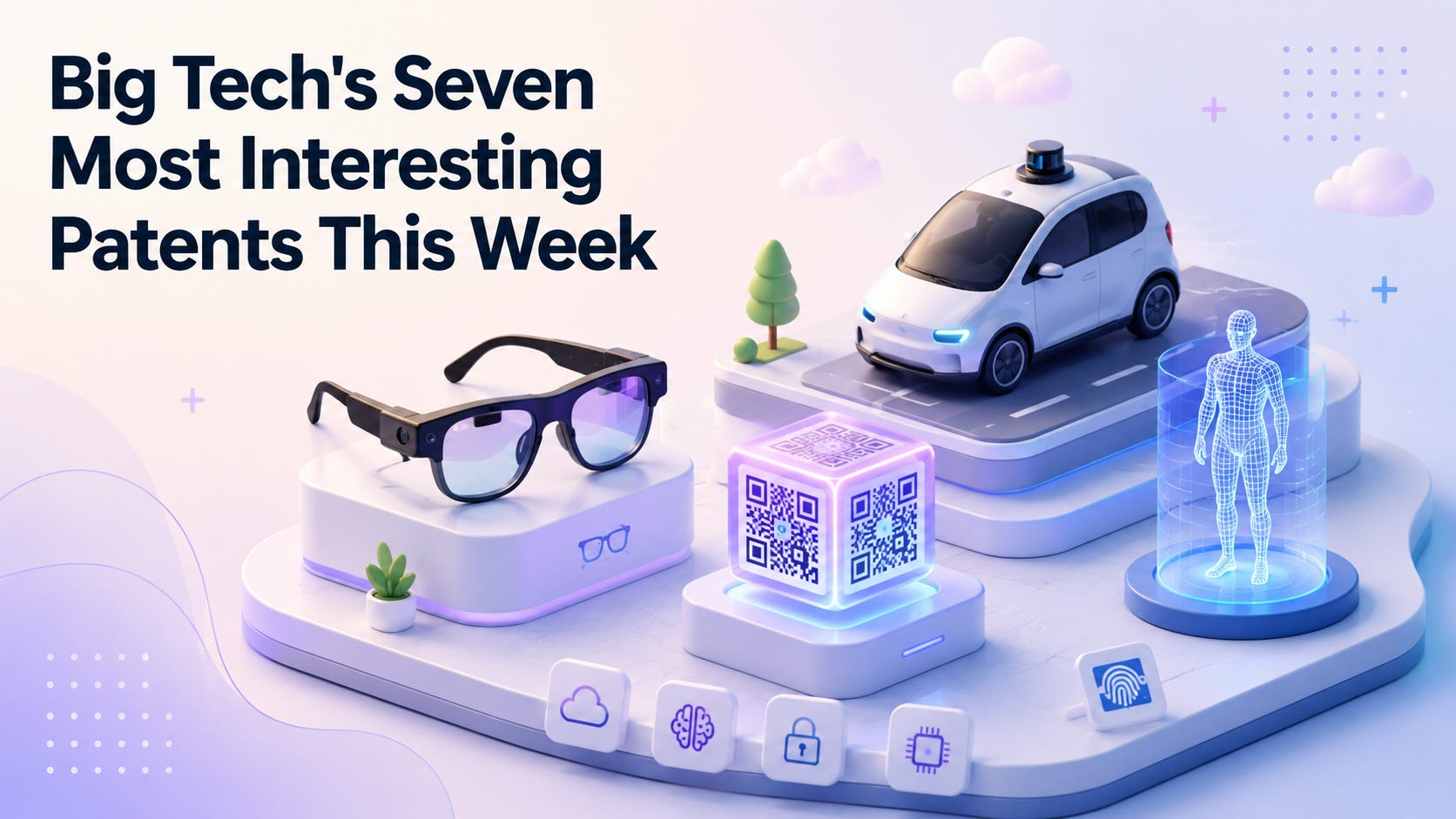
Most weeks, the patent record is a long exercise in incrementalism — a slightly faster cache here, a marginally better antenna there. The skill in reading it is knowing which of the hundreds of filings actually tell you something about where these companies think the world is going.
This week gave us a good batch. We pulled the latest filings from the companies we cover and picked seven that were worth stopping on — a few charming, a few genuinely useful, one or two that read like the opening scene of a science-fiction film. All of them are real, and all of them were filed in the last few days.
1. Apple patents an avatar that reconstructs the face its own headset is hiding
Here’s a problem you only get to have once you’ve shipped a face computer: when you wear Apple’s Vision Pro and take a sip of coffee, the lower half of your digital “Persona” avatar can drop out, because the headset can’t see the part of your face the cup is in front of. Apple’s filing is the fix — a system that reconstructs the occluded parts of your face so the avatar stays whole while you’re, say, drinking.
It’s not the kind of patent that makes headlines, and that’s exactly why it’s interesting. Consistent avatar quality during ordinary, messy real-world use is precisely where spatial computing succeeds or fails, and Apple is clearly treating Persona as a platform worth this kind of unglamorous polish. Here’s our full breakdown of Apple’s patent for reconstructing occluded faces on Vision Pro avatars.
2. Meta patents Ray-Ban glasses that ask you what you meant
Point your smart glasses at a cluttered desk and say “remind me about this,” and the glasses face a small crisis: which this? Meta’s filing handles that moment gracefully — instead of guessing and getting it wrong, the glasses show you a visual menu and let you pick the object you meant.
What we like here is the restraint. Meta isn’t trying to make the vision model more accurate; it’s building a polite fallback for the inevitable moments when accuracy isn’t enough. That instinct — designing for the failure case, not just the demo — is usually what separates a gadget people abandon from one they actually wear. Read our write-up of Meta’s object-disambiguation patent for Ray-Ban smart glasses.
3. Microsoft patents software that refuses to let your virtual hand raise be ignored
We have all lived this one. You raise your hand in a video meeting, the conversation rolls right over you, and the moment passes. Microsoft has filed for a system that watches the meeting’s topic flow and makes sure a raised hand actually gets surfaced at the right time, rather than dissolving into the void.
The technically interesting piece is the topic-detection layer that decides when your point is still relevant. The rest is sensible meeting-interface logic. Whether it ships inside Teams or quietly stays in the backlog, it’s the rare patent aimed squarely at a small daily indignity — and those are often the ones people end up loving. More on Microsoft’s AI-powered hand-raise alerts for video meetings.
4. Google patents a QR code that hands out a fake email instead of your real one
Networking events run on a small act of regret: you give a near-stranger your real email address, and your inbox pays for it for years. Google’s filing offers a cleaner trade — a QR code that, when scanned, dispenses a functional alias address that forwards to you, so you can hand out contact info without handing over your actual inbox.
Alias email is a proven privacy tool; the new wrinkle is pairing it with a QR code for frictionless in-person sharing, which none of the big platforms have done cleanly yet. Drop this into Gmail or Google Wallet and it could quietly become the default way people swap contact details at a conference. See the full breakdown of Google’s QR codes for private, aliased email sharing.
5. Apple patents a QR code that proves you were actually there
Sticking with QR codes for a moment: Apple’s filing uses them not to share information but to cryptographically prove that a specific device was physically present at a specific moment. Think of it as the difference between showing a ticket and proving the ticket is being shown by the right phone, in the right place, right now.
It’s quiet security plumbing, but the problem it addresses — screenshotted tickets, shared access codes, “proof of presence” that proves nothing — has dogged ticketing and access control for years. The session-binding approach is pragmatic, and this is exactly the kind of infrastructure that tends to ship without fanfare inside something like Wallet. Read more on Apple’s proof-of-presence QR code patent.
6. Waymo patents a backup brain for when a robotaxi’s computer fails at 65 mph
This is the one that made us sit up. Waymo filed for a dual-brain hardware architecture that handles a genuinely unnerving scenario: what a self-driving car should do when its primary computer partially fails on a freeway. The answer is a second system that can take over and bring the vehicle to safety — either pulling onto the shoulder or quietly exiting to a surface street — with no human ever touching the wheel.
The specificity is the tell that this is real safety engineering rather than a feature flag. The filing distinguishes between failure types and matches them to distinct fallback outcomes, which is the unglamorous, high-stakes work that actually determines whether robotaxis are safe to scale. See the details of Waymo’s redundant-hardware fallback patent for autonomous vehicles.
7. Nvidia patents a foundation model that builds full 3D humans from internet photos
And the science-fiction capstone: Nvidia’s filing describes a single AI model that generates a complete, photorealistic 3D human — face, hands, full body — trained almost entirely on ordinary 2D photos pulled from the open web, with no 3D capture studio in the loop.
The technical lift here is steep, combining a full-body generative model with 3D rendering techniques in a way few groups have the compute or the talent to attempt. Whether or not this exact filing becomes a product, it’s a clear marker of where Nvidia thinks digital humans are headed — and a reminder that “scraped 2D photos in, fully posable 3D person out” is no longer a hypothetical. Read the full piece on Nvidia’s 3D digital-human foundation model.
What this week told us
If last week’s filings read like a sci-fi prompt list, this week’s read like a product roadmap. The throughline wasn’t novelty for its own sake — it was companies sanding down the rough edges of things they’ve already shipped or are about to. Apple polishing avatars and ticketing. Meta designing for the moment its glasses get confused. Microsoft fixing a meeting annoyance. Google and Waymo doing the quiet privacy and safety plumbing that products live or die on. And Nvidia, as usual, filing from a few years in the future.
The patent record is a slow leading indicator, and most of these will look different by the time they ship — if they ship at all. But taken together, the picture is of an industry past the “what if” stage on AI, headsets, and autonomy, and well into the “make it actually usable” one.
We’ll be back with next week’s batch.